
When Love Makes You Pay Closer Attention
Something Feels Different. But You Can't Quite Put Your Finger On It
For the Daughter or Son Who Suspects Something Has Changed with Mum or Dad.
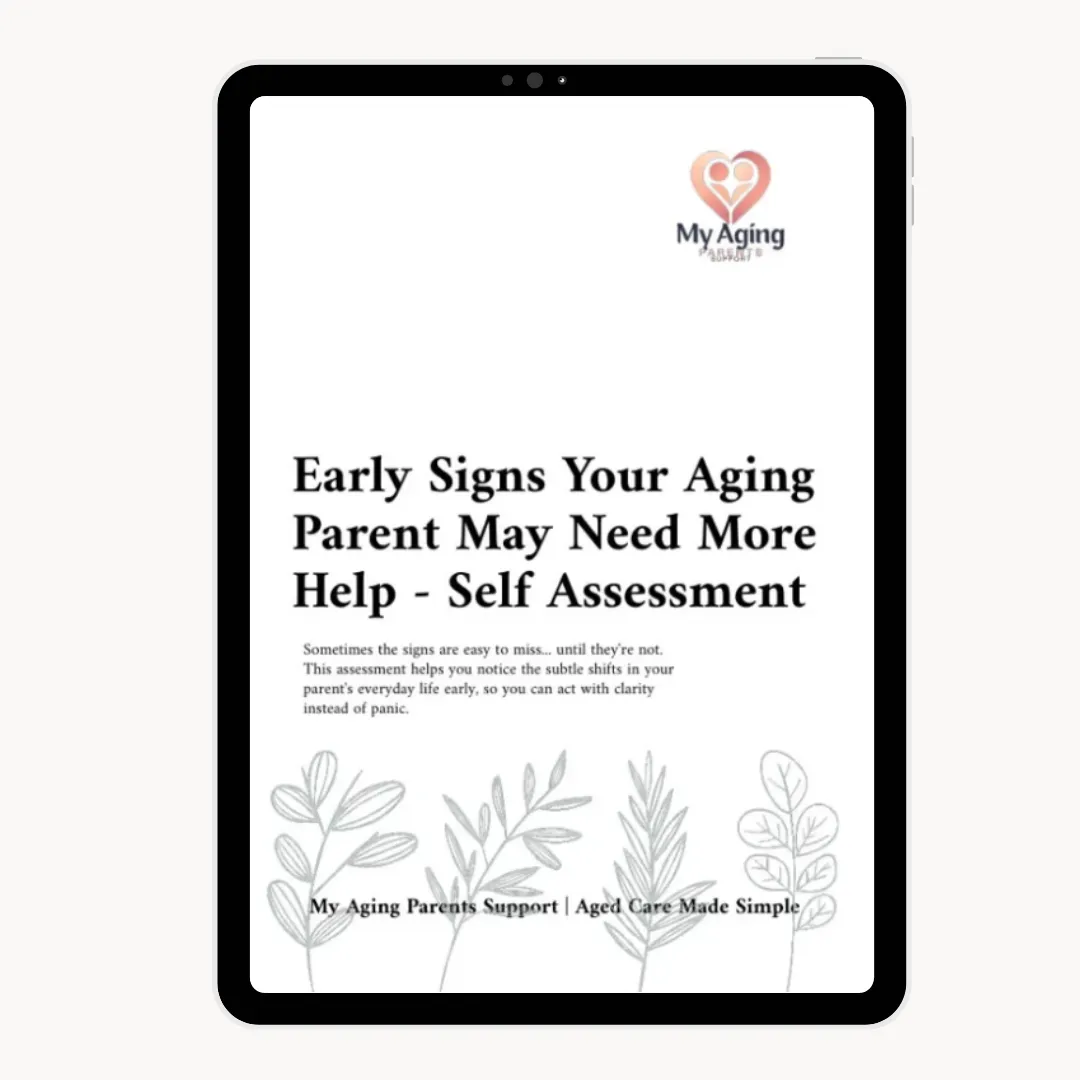
This self-assessment helps you spot the early signs your aging parent may need more support at home. Go room by room, step by step, at your own pace so you can act with knowledge and insight instead of panic.
45+ pages. Revisit every 3–4 months to track changes over time.
🔒 Secure checkout. Immediate download.

Finding this assessment is already a step in the right direction.
I know that quiet worry. I lived it. I watched my own mum and told myself the same things like it's just getting older, she's fine, I'm probably overreacting. Until I wasn't.
Most families don't see it coming until something forces their hand. A fall. A phone call. A moment that changes everything overnight.
This assessment exists so you don't have to wait for that moment.
Consider this your first step towards seeing clearly instead of second-guessing yourself.
we see you
You've Noticed Something. You're Just Not Sure What.
It's not one big moment. It's a hundred small ones.
The fridge that's half empty when it never used to be. The mail piling up on the bench. The bruise they can't quite explain. The joke they told you twice in the same conversation.
You tell yourself it's just getting older. That everyone forgets things sometimes. That they're fine.
But something in you isn't so sure.
And that quiet worry? It deserves an answer.
Noticing changes but not knowing if they're serious enough to act on
Feeling like you're watching for signs but not sure what you're actually looking for
Worrying that by the time it's obvious — it'll already be a crisis
Not wanting to overreact, but terrified of under reacting
Carrying this worry quietly because you don't want to alarm anyone yet
WHAT'S INSIDE The Early signs your aging parent may need more help?
An Insightful
Self-Assessment You'll Return to Again and Again
This isn't a generic checklist. It's a 40+ page guided self-assessment built from real observations and designed to help you see clearly what's changing, what it means and when it's time to step in and advocate for your parent.
Here's what's covered:
Kitchen & Nutrition: Is your parent eating well and managing meals safely? The kitchen tells you more than you'd expect.
Personal Hygiene & Self Care: Subtle changes in how they look after themselves are often the first signs something has shifted.
Home Environment & Safety: A room-by-room safety check for the hazards that are easy to miss until someone gets hurt.
Cognitive Function & Memory: What's normal forgetfulness and what's worth paying closer attention to.
Financial & Administration: Unpaid bills, confusion over money and missed appointments can be quiet red flags.
Medication Management: Are they taking the right things at the right times? This section helps you find out.
Mobility & Physical Function: How they move, balance and get around tells you a lot about their safety at home.
Social Connection & Mental Health: Isolation and withdrawal are often overlooked — and deeply important
45+ pages: yours to observe and record every couple of months

Revisit every few months to track changes over time. Because knowing how things are shifting gives you the power to act early instead of in an emergency.
how it works
Simple. Honest. Eye-Opening.
This self-assessment isn't about looking for problems.
It's about clear observations so you can respond with love and confidence instead of panic and stress.
Because seeing it clearly is the first step to doing something about it.
.
01
Assess
Work through each category at your own pace. You don't need to do it all at once. Even completing one section gives you valuable insight you didn't have before.
02
Track
Note what you observe and when. Revisit every 3–4 months to build a picture of how things are changing over time because patterns matter more than single moments.
03
Act
Use what you learn to have clearer conversations, make more informed decisions and know exactly when it's time to take the next step with confidence and without the panic.
Want Everything for This Stage in One Place?
Upgrade to The Complete Start Bundle - Save 15%
This self-assessment is an essential first step. But if you want complete coverage for this stage of the journey and get every guide, planner and checklist then the Complete Start Bundle has everything you need.
Work through these resources and you'll have everything you need and be completely organised... not just for today, but for the decisions that come next.
Because this journey is just the beginning and their support needs will change overtime too.
These resources set you up for right now and prepared you for whatever comes next. Because being prepared today means fewer surprises (and stresses) tomorrow.
My Aged Care Quick Start Guide
Starting The Conversation about Aged Care with your Parents — $29 Value
The Essential Aged Care Simplified Roadmap — $29 Value
Early Signs Your Aging Parent May Need More Support — $39 Value
The Essential Life Admin Organiser for Aging Parents— $29 Value
Total Real World Value: $126 BUNDLE & SAVE 15%
The Complete Start Bundle Summary

Get the 5 essential aged care resources now: Include step‑by‑step checklists and planning tools you need that help you start your parent’s aged care journey & get everything organised to get the support they need.
Buy Now | Start Now
as every day counts.
$126$107
🔒 Secure checkout. Quick download.
REASSURANCE FOR THE JOURNEY
Commonly Asked Questions
Getting started is often the hardest part. These are the questions we hear most from daughters and sons just like you. So you know exactly what to expect.
What if I'm not sure my parent actually needs more help yet?
That's exactly who this assessment is for. You don't need to be certain, you may have that quiet gut feeling that something might have changed. This gives you a structured way to look clearly at what's actually happening, rather than second-guessing yourself.
How long does the assessment take?
You can work through it in one session or section by section over a few days. There's no right or wrong way. Most people find that even the first category gives them a head start on understanding that they didn't have before.
How often should I do this assessment?
We recommend revisiting it every 3–4 months or sooner if something changes suddenly. Tracking changes over time gives you a much clearer picture than any single snapshot can.
Is this a digital download or a physical book?
It's an instant digital download in PDF format so you have it immediately. You can read it on your phone, tablet or computer or print it at home and use it as a workbook (recommended). Many families print it out and work through it section by section and have it handy.
What if the results show things I wasn't expecting?
Firstly... take a breath. Seeing something clearly is always better than missing it. The assessment doesn't tell you what to do, instead it helps you understand what you're looking at so you can make informed, loving decisions about next steps.
Is this relevant if my parent seems fine right now?
Yes, especially then. The early signs are really easy to miss. They are subtle and they're much easier to spot when you know what to look for before anything becomes an emergency and urgent. Many people tell us they wish they'd done this sooner.
Can this assessment help when my parent has their My Aged Care assessment?
Absolutely. One of the most valuable things you can do before an aged care assessment is have a clear, documented picture of how your parent has changed over time. This self-assessment gives you exactly that: a record of their changing needs and shifting abilities that helps you speak up confidently and advocate for the level of support they truly need.
Can I share it with a Friend?
We would love you to share our website with a friend, there is a share button below here to make it easy. Thank you.
Share This Page With Someone Who Needs It
My Aging Parents Support | Aged Care Made Simple


Created from real experience. Written daughter-to-daughter/son. Designed to help you see clearly before a crisis makes the decision for you.
A Daughters Guide - What I wish I Knew...
© 2026 My Aging Parents Support | AgedCareMadeSimple.com.au . All rights reserved.